


Even Superhuman Isn't Enough: What Supergirl Taught Me About My Own Film
- Jane Larkin

- 2 days ago
- 3 min read
by Jane Larkin - July 27, 2026
After scrolling platforms online, I’ve come across heavy criticism of the recent Supergirl film. I’ve also come across insightful articles looking into why women in capes need to work twice as hard. Superheroes, as long as they have a penis, are allowed to exist in mediocrity, but female superheroes are heavily criticised. I have had a very recent, personal experience that has faced this sexist dilemma.

I am a filmmaker, so am used to cinephiles - and healthy criticism towards any film - but not all criticism is created equally. My debut feature The Edge has been the victim of criticism, yes, but also hate speech. Although it took some work, and I did have to report them, I got various film sites to remove the hateful comments from our The Edge page. "Sick of [word redacted]", said one hater, along with another joke about “women in the kitchen”, our powerlifter being “a bloke”, and me being “pathetic”. This got me thinking: the criticism did not seem to be directed towards our film, but, rather, the women in it. Is the "manosphere" to blame for this hostility towards female characters, or is this something that has always existed in our society? While I did find some criticism of James Gunn’s “woke” agenda” with Superman, I also found positive articles, highlighting how James Gunn “aims right for the heart with Superman”. However, what I wasn’t able to find was criticism directed towards David Corenswet’s portrayal of the titular character, and, particularly, his appearance. In contrast, most of the Supergirl criticism is directed towards Alcock’s looks, and the way she carried herself in press appearances. The general vibe was the patronising demand that echoes the socialisation of women: that she needs to smile more.
My debut feature film The Edge was purchased by Netflix ANZ after premiering at the Gold Coast Film Festival in 2025. It has also won numerous awards, a fact I’m incredibly proud of. This isn't to say that people cannot critique my film, or any other film. It's just that a huge amount of criticism for both The Edge and Supergirl focus on what should be irrelevant. And, despite these aforementioned awards across numerous categories - for the script, its actors, and its direction (I wrote, directed, produced and starred in it) - I, like James Gunn’s Supergirl and its star Milly Alcock, have received criticism that’s all too familiar, and, perhaps, predictable.
The first of this blatant sexism occurred when I pitched the project. I was told that female athletes were not as marketable as their male counterparts, and, not only that, I was not choosing the “sexy sports” women were allowed to be good at. I was not choosing dancing, or cheerleading, or whatever sport the mansophere has deemed appropriate. I wanted a powerlifter, a paralympian and a sprinter who threw up on track. Despite the constant pressure to change my characters, I stayed on track, and, when funding from Screen Queensland and Screen Australia never came through, I turned to private investors, and alternate funding, at great personal expense.
Throughout the filming I was surprised at what I saw and heard: simultaneously I was told that I had written a masterpiece and a flop, and I probably don’t need to tell you which gender said which. Or that my employees, or “inferiors” on a working set felt empowered to tell me what would work “better”, which, to be honest, felt akin to an unsolicited dick pic. Women told me they felt heard; men told me I should make the women sexier. And, with none of the female leads ending up with a man, what message was I sending? The right one, I hope.
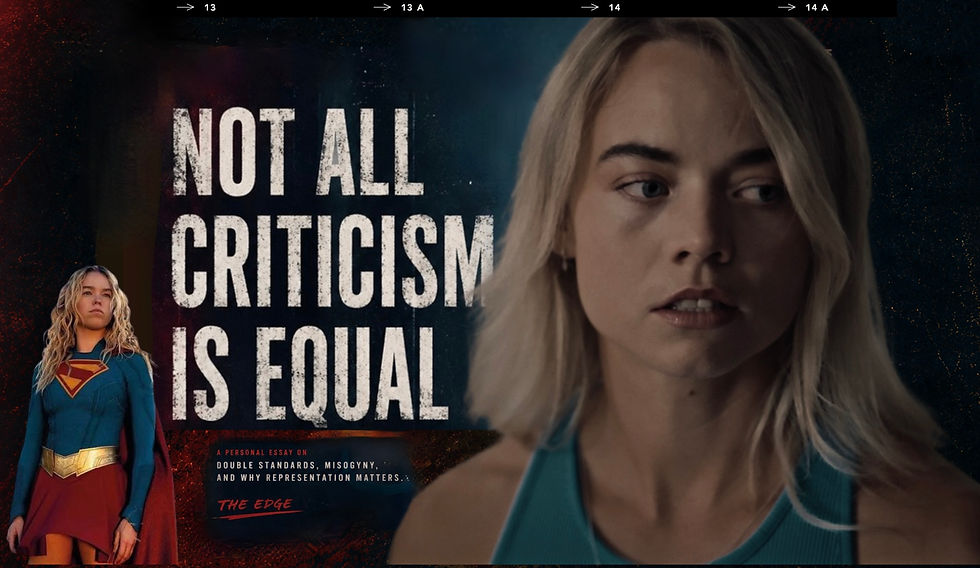
Recently, ELLE Magazine stated “Every time a female superhero arrives on our screens, she carries a burden...", and this struck me. With the first ever Paralympic lead, our athlete turned actor, Mei Ichinose, said she didn’t feel the normal pressures of a performative set, but that she was representing every para-athlete. Every little girl who knew she was different. When the awards continued, and the hate mail increased (to this day I still receive angry emails from men asking me about my “woke” agenda), I realised over time that the problem was not with my film, but with the audience. When women don’t like the sound of an action flick, they simply choose not to watch it, but when men get angry at something, they, seemingly, don’t stay silent.
So, if Supergirl - an actual superhuman, played by a talented actress, and backed by one of the biggest studios - still isn’t good enough, what is? If the superhuman woman is still falling short of men’s expectations, what chance do us women, as mere mortals - even the very strong and capable of us - have?


Comments