


Women on screen are still judged by different rules

Updated: Aug 25
Jane Larkin 20 August 2026
My debut feature film, The Edge, was purchased by Netflix ANZ after premiering at the Gold Coast Film Festival in 2025. It’s a film about three young women — an Aussie sprinter, a First Nations powerlifter and a Japanese Paralympic swimmer — navigating love, education and controversy while embedded in the world of elite sport. I wrote, directed, produced and starred in it, drawing on my own experiences as an elite Australian sprinter. It has since won numerous awards across several categories, including writing, acting and directing, and I am incredibly proud.
To say that the project was a ‘labour of love’, however, undersells just how difficult it was to make — and sell. I’ve heard it said that every film is a miracle. If that’s the case, it’s worth noting that, in 2025, only nine female directors worked on the 100 top-grossing films of the year. So what does that say about the ‘miracle’ when you’re an under-represented woman in a man’s world, still trying to pull it off?
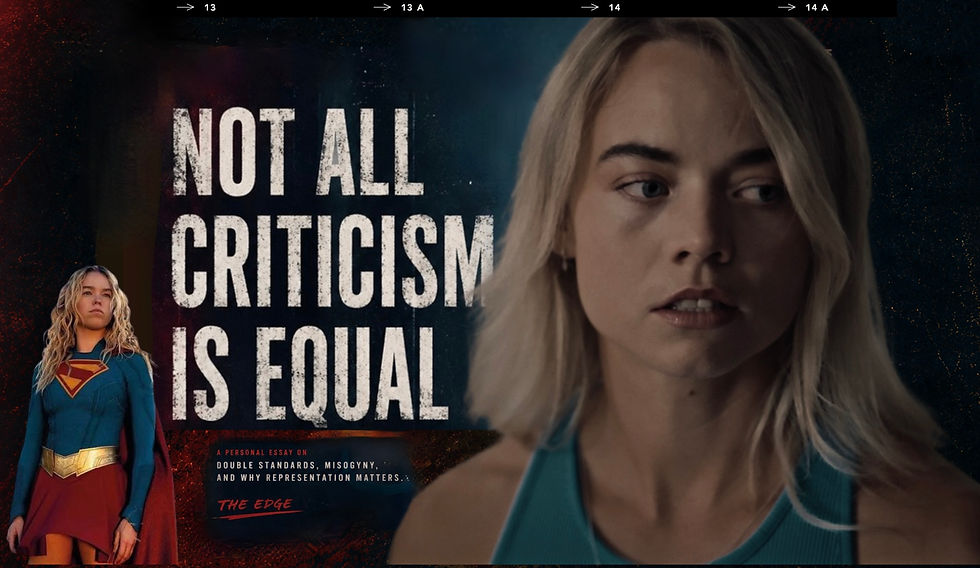
From the start, there was immediate, blatant sexism when I pitched the project. I was told that female athletes were not as marketable as their male counterparts. Not only that, but I had not chosen the ‘sexy sports’ women were allowed to be good at: dancing, cheerleading or whatever sport men deemed appropriate. I wanted a powerlifter, a Paralympian and a sprinter who threw up on the track. Despite the constant pressure to change my characters, I stayed ‘on track’ (pun intended) and, when funding from Screen Queensland and Screen Australia didn’t happen, turned to private investors and alternative sources of funding, at great personal expense.
Throughout filming, I was surprised at what I saw and heard. I was simultaneously told that I had written a masterpiece and a flop, and I probably don’t need to tell you which gender said which. Nor do I need to explain what it was like to have my employees — on a working set — offer unsolicited instructions about what would work ‘better’, which, to be honest, felt akin to them sending me an unsolicited dick pic. Women told me they felt heard; men told me I should make the women sexier. And with none of the female leads ending up with a man, what message was I sending? The right one, I hope.
Then the film was released and different criticisms arrived. ‘Sick of cripples,’ said one hater, (referring to our incredible Paralympian). Others ‘joked’ that ‘women should be in the kitchen’, our powerlifter looked like ‘a bloke’, and I was ‘pathetic’. This got me thinking: the criticism did not seem to be directed towards our film, but rather towards the women in it. Is the ‘manosphere’ to blame for this hostility towards female characters, or is it something that has always existed in our society? Then, within 12 months of my film’s release, Supergirl arrived on our screens.

“If a superhuman woman still falls short of men’s expectations, what chance do ‘mortal’ women have?”
Supergirl had a proven and talented star in Milly Alcock, a seasoned director in Craig Gillespie, and the backing of one of the biggest studios in the world — a lot of things my film didn’t have. Yet a huge proportion of the responses to it had nothing to do with the film itself. Alcock has spent months fielding commentary about whether she smiles enough in press appearances and whether she’s ‘hot enough’ for the role. Nor is Supergirl an isolated case. Female-led superhero films have repeatedly become lightning rods for hostility that extends beyond criticism of the films themselves. Madame Web received an unusually hostile reception, while Scarlett Johansson’s legal team accused Disney of launching a ‘misogynistic attack’ against her during their dispute over the release of Black Widow.
However, recent box-office successes such as Captain Marvel and Wonder Woman show that female-led blockbusters can and do succeed commercially, even when their stars depart from narrow Hollywood beauty standards. But the fact is that women are more often judged according to expectations around attractiveness, femininity and likeability. Recently, Elle stated that ‘every time a female superhero arrives on our screens, she carries a burden …’, and this struck me.
As the first Paralympic lead in an Australian feature film, our athlete-turned-actor Mei Ichinose said she didn’t feel the usual pressures of performing on set, but felt that she was representing every para-athlete: every little girl who knew she was different. When the awards for The Edge kept coming — but so did the hate mail (13 months into its Netflix run, I still receive angry emails from men about my ‘woke’ agenda) — I finally realised that the problem was not my film, but certain audience members. When women don’t want to see an action flick, they simply choose not to watch it. Some men, in contrast, treat the same lack of appeal as a reason to become angry that the film was made at all, and make sure the filmmakers know about it.
There was some discussion about David Corenswet’s appearance in the recent Superman. Corenswet spoke in interviews about wanting a ‘farm-boy build’, rather than the ‘imposing physique’ showcased by Henry Cavill, and the reception to this choice was warm and admiring. In contrast, Alcock was judged for her looks and her portrayal of the character, even though Superman and Supergirl are vastly different characters. Superman is written as warm and sincere — especially James Gunn’s version — whereas Gillespie’s Supergirl is jaded, prickly and quite openly working through grief.
This raises another interesting question about character likeability — and, specifically, gender and likeability — which is something else I can relate to. Like Alcock’s Supergirl, the character I wrote and play in The Edge, Annie Murphy, is struggling with grief following her best friend’s suicide. Yet I was repeatedly asked whether Annie was likeable enough.
Why can abrasiveness be treated as charisma, in both heroes and antiheroes, as long as the character has a penis, whereas it often reads as unlikeability in women? In men, abrasiveness or standoffishness is considered attractive — think of Han Solo in Star Wars — but in women, it’s hostility. In men, it’s determination; in women, it’s obnoxiousness. In men, it’s leadership; in women, it’s bossiness.
Obviously, there are exceptions. Considering the enduring popularity of Ellen Ripley and Sarah Connor, you’d think we would be well prepared for strong female leads, especially some 40 years on from those characters’ debuts. It is worth noting, however, that Alien and The Terminator were both written by men — Dan O’Bannon and James Cameron, respectively — whereas the recent Supergirl and The Edge were written by women. Perhaps audiences more readily accept female characters written by men because male authority lends them legitimacy, whereas women, whether characters or writers, are still expected to earn the audience’s interest first.
After much thought, I’ve come to the following conclusion: if Supergirl — an actual superhuman character, played by a talented actress and backed by one of the biggest studios in the world — isn’t good enough, what is? If a superhuman woman still falls short of men’s expectations, what chance do ‘mortal’ women have?


Comments